
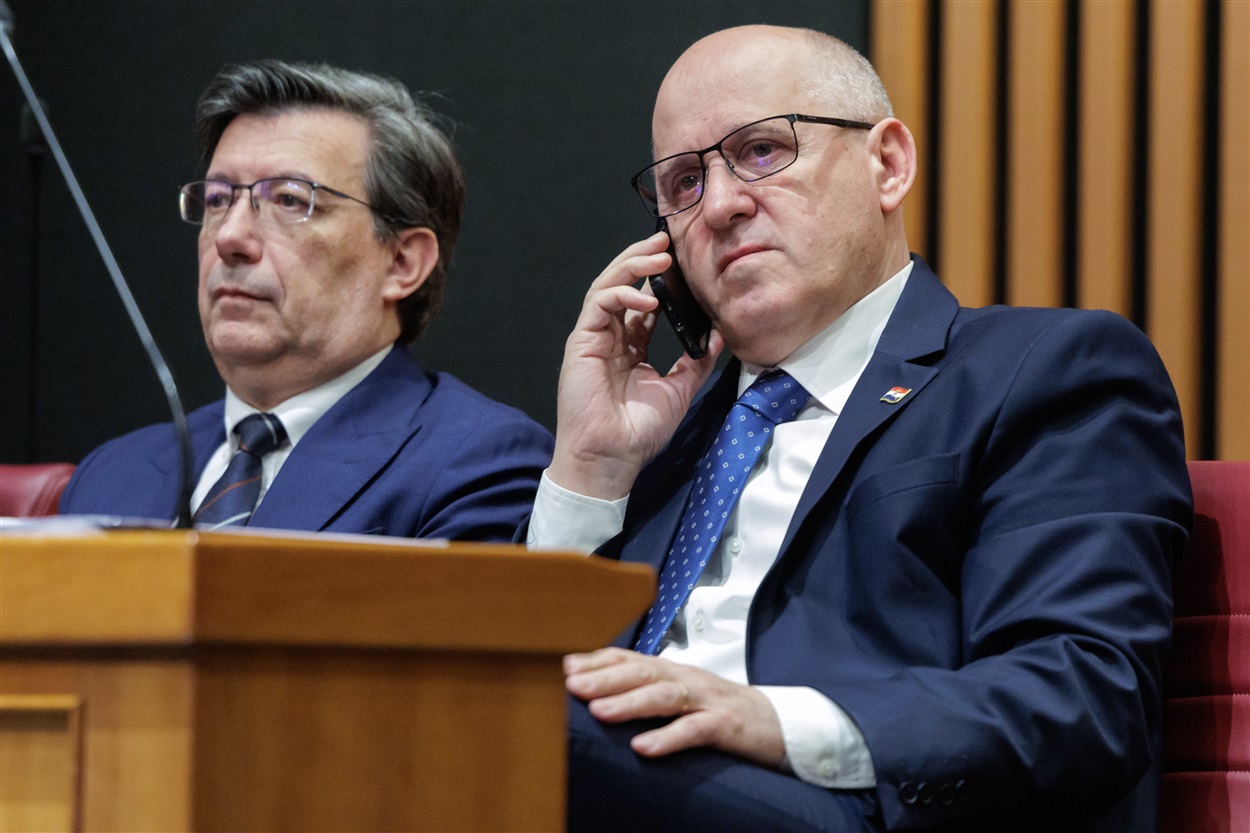
Zagreb - Physical Planning, Construction and State Assets Minister Branko Bačić told parliament on Wednesday that the government’s affordable housing bill aims to slow rising property prices and increase the number of affordable homes.
“This is a process that will not immediately deliver affordable housing, but we are confident that through laws on building maintenance, property tax, housing in assisted areas, rental apartments and spatial planning, we can increase the number of housing units, activate units and build new ones, thereby curbing property price growth,” Bačić said while presenting the bill.
The state plans to build and renovate 20,200 apartments and family homes over the next four years, including 8,000 new units through the state-owned APN real estate agency, while 9,000 apartments will be brought into affordable housing use by activating empty units.
The plan foresees an investment of €2 billion by 2030 and an additional €3.5 billion by 2034, with funding provided by the state, cities and municipalities, APN and financial institutions.
Citizens eligible for affordable housing will not be able to sell the property for 35 years, except in exceptional cases, with the right of first refusal held by the local authority and then by APN.
Bačić said multiple factors have contributed to the affordable housing challenge, including Croatia’s EU membership making properties accessible to EU citizens, the energy crisis following Russia’s aggression against Ukraine driving construction costs up, and excess household income being invested in real estate.
“This has led to around 40% of Croatia’s 2.3 million housing units being unused for residential purposes, either left empty or used for short-term rentals, offices and similar purposes,” he said.
This law is a colourful lie, says opposition
Ante Kujundžić of Bridge said the law would not help those without parental assistance but would instead strengthen a segment of society “with capital in its pocket”. Had the state wanted to pursue structural reform, he said, it would have introduced a luxury tax or created a state fund for young people.
“The law offers a big colourful lie,” said Anka Mrak Taritaš of GLAS. She noted that while the government says 20,200 homes will be brought into use over the next three years, including 8,000 newly built units, only 920 apartments were constructed over 10 years under Prime Minister Andrej Plenković through the subsidised housing scheme known as POS.
Marijana Puljak of Centre said that if the aim was to solve the problem for many rather than a few, housing supply must be drastically increased. “Without volume there is no price stabilisation, and we will not increase supply if infrastructure construction remains stalled,” she said.
Mišo Krstičević of the Social Democratic Party said Croatia’s housing shortfall was ten times greater than the solutions on offer, citing a 2021 study by the Economics Institute estimating that the country lacks 237,000 apartments.
The planned construction of 8,000 new units by 2030 was also questioned by Dalibor Paus of IDS, who said expectations must be realistic. “That amounts to roughly 2,000 housing units a year, while so far we have had around 350 units annually through POS,” he said.
Independent lawmaker Marija Selak Raspudić called for minimal state intervention to improve market conditions, urging the government to “tighten its own belt” and proposing tax relief for long-term rentals.
Marin Živković of We Can! urged the government, if it was serious about affordable housing policy, to take opposition criticism and proposals into account.
Bill marks major step forward, say ruling parties
Lawmakers from the ruling majority said the affordable housing bill marked a major step forward and addressed real challenges in the property market.
“The state is finally assuming a more active role in creating housing policy and is seeking to address challenges in a systematic way, clearly defining for the first time what affordable housing means,” Predrag Štromar of the HNS said, adding that the range of solutions was being broadened.
Mato Franković of the HDZ said the law responded to real challenges, recognised citizens’ needs and took a strategic view of the future.
“The issue of housing is no longer merely a personal or family matter; it has become one of the key social, economic and demographic issues of our time. Without a secure and affordable home, there can be no long-term planning, starting a family or keeping young people in Croatia,” he said.