
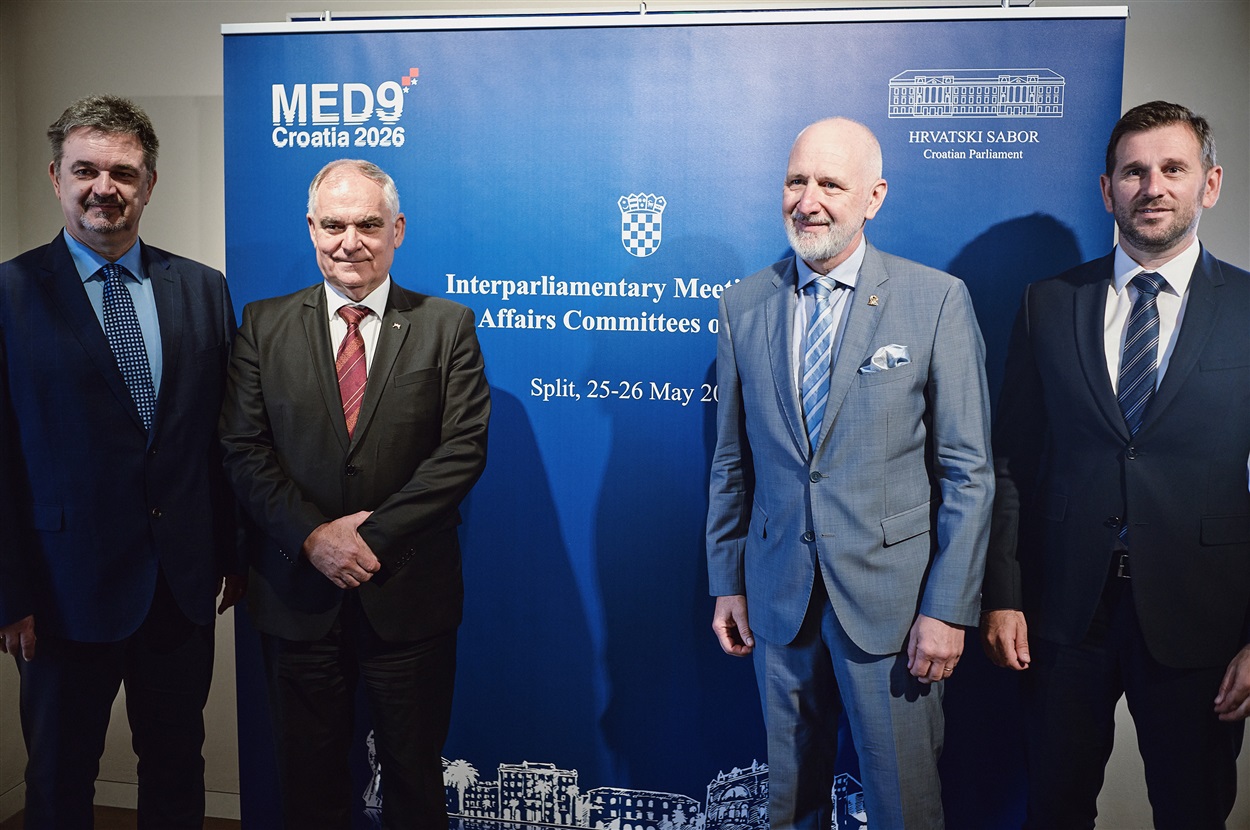
Split – Chair of the Foreign Affairs Committee of the Croatian Parliament Andro Krstulović Opara opened the Interparliamentary Meeting of MED9 Foreign Affairs Committees together with the Mayor of Split, Tomislav Šuta, and the Prefect of Split-Dalmatia County, Blaženko Boban. The meeting brought together members of foreign affairs committees from MED9 member states, Members of Parliament from Bosnia and Herzegovina, Albania and Montenegro, as well as representatives of European institutions, academia and other distinguished guests.
Krstulović Opara underscored the importance of parliamentary diplomacy and stronger cooperation within the parliamentary dimension of MED9. He noted that the Croatian Parliament began strengthening this dimension in 2022 with the first Parliamentary Summit of the International Crimea Platform and continued this effort with the Parliamentary Summit of the Three Seas Initiative held in March this year.
Krstulović Opara noted that this was the first meeting held as part of the parliamentary dimension of MED9 and expressed hope that this format would continue to grow stronger and foster effective cooperation on Mediterranean issues. He also highlighted the role of parliamentarians, who are often able to engage more directly and openly than the executive branch, and called for continued cooperation within this important framework.
Presenting the title of the meeting, Mistral of Change: The Mediterranean as a Source of Strength for Europe’s Future?, Krstulović Opara explained that the mistral — the strong north-westerly wind characteristic of the Mediterranean — symbolises the profound changes and transformations shaping both Europe and the Mediterranean region. The aim is to present the Mediterranean not only as an area facing shared challenges, but also as a source of resilience, cooperation and European strength. He stressed that the new Adriatic paradigm, extending to the Mediterranean as a whole, calls for a more active Croatian Adriatic and Mediterranean policy — one that places the Mediterranean at its centre while promoting regional security and stability.
Krstulović Opara also presented the concept of the meeting and its panel discussions, noting that all debates would be held under the Chatham House Rule in order to encourage open and substantive exchanges of views.
In his introductory remarks, State Secretary for Foreign Trade and Development Cooperation at the Ministry of Foreign and European Affairs Zdenko Lucić addressed the challenges facing Europe and the region, particularly in the areas of energy security, migration, economic development and political stability. He stressed the need to expand renewable energy capacity, improve infrastructure and ensure a coordinated European response to crises. Recent crises, he noted, have underscored the importance of investing in energy infrastructure, diversifying energy supplies and strengthening regional cooperation. Lucić also highlighted the importance of cooperation between Mediterranean and Balkan countries, stronger protection of the European Union’s external borders and closer coordination among member states.
Presenting the agenda of Croatia’s MED9 Presidency, he reiterated the need for dialogue and joint action to safeguard the region’s stability and security. He concluded that cooperation within the MED9 framework enhances coordination among participating countries and contributes to the development of common policies aimed at ensuring peace, economic prosperity and a safer future for European citizens.
In his address, Deputy Speaker of the Croatian Parliament Ivan Penava welcomed the Interparliamentary Meeting of MED9 Foreign Affairs Committees as an important opportunity to exchange views, experiences and strategic perspectives on issues of common interest to the Mediterranean region — an area that today stands more than ever at the heart of Europe’s geopolitical, security and economic agenda.
He particularly highlighted Croatia’s role as this year’s chair of the MED9 Group, stressing that the Group is one of the European Union’s key regional formats. Its member states account for around 40 percent of the EU’s territory and generate 60 percent of Europe’s tourism revenue. Referring to the Pact for the Mediterranean, Penava said it “provides an important framework for strengthening the shared Mediterranean space — from the development and transmission of clean energy to stronger economic connectivity and infrastructure cooperation.”
He also underlined that the Mediterranean forms an important part of Croatia’s national identity and development, particularly through tourism, while stressing the importance of sustainability, resilient infrastructure and environmental protection.
Penava concluded that parliamentary diplomacy and interparliamentary dialogue play an important role in building trust and shaping common European policies. He expressed confidence that the meeting in Split would further strengthen cooperation among states and institutions for the benefit of citizens across the European Union and the Mediterranean region.
Participants were also addressed by European Commissioner for the Mediterranean Dubravka Šuica. Commissioner Šuica highlighted Croatia’s active role during its MED9 Presidency and its contribution to strengthening dialogue and partnerships across the Mediterranean, particularly through the organisation of the first European conference on the Pact for the Mediterranean, held in Zadar.
She emphasized the important role parliamentarians play in strengthening public understanding of and support for European policies, describing interparliamentary cooperation as essential for building trust among states and fostering effective dialogue at a time when common solutions are more necessary than ever.
Addressing the challenges facing the Mediterranean today — including instability in the Middle East, migration pressures, organised crime, and energy and climate-related challenges — Šuica stressed that Europe must respond responsibly and with a long-term strategic vision. She particularly highlighted the role of MED9 countries, which stand on the frontline of these challenges while also helping shape a common European response.
Referring to the Pact for the Mediterranean, Šuica reaffirmed its importance as a framework for practical cooperation in the fields of security, the economy, energy, migration and relations between the European Union and partner countries. She also recalled that the European Commission had further underlined the strategic importance of the region by establishing a dedicated Mediterranean portfolio and proposing €42.5 billion in funding for cooperation with Mediterranean and Gulf countries under the next Multiannual Financial Framework.
Šuica also stressed the importance of investing in young people, noting that the first pillar of the Pact places people, education and interpersonal connections at the heart of long-term stability. In this context, she highlighted the initiative to establish a Mediterranean University as a platform for cooperation, knowledge exchange and stronger connections among young people across the region.
On security issues, she underscored the importance of cooperation with Southern Mediterranean partners in combating organised crime, migrant smuggling and human trafficking, as well as the need for responsible migration management. She also stressed the importance of strengthening societal resilience to climate change, wildfires and other crises.
Speaking on energy, Šuica pointed to the Southern Mediterranean’s significant renewable energy potential and noted that Europe is developing new partnerships in renewable energy, electricity grids and hydrogen in order to strengthen the region’s energy security and competitiveness.
She reaffirmed the importance of bilateral partnerships as investments in long-term global stability and stressed the need for cooperation and joint solutions. Šuica described the European Union’s Mediterranean policy as complex and long-term in nature, calling it a “new philosophy for the Mediterranean.”
In closing, she reiterated that the stability and European perspective of the Western Balkans are of strategic importance to both the European Union and the Mediterranean region. She concluded that partnerships across the Mediterranean represent an investment in long-term stability, trust and a safer future for Europe, adding that “the Mediterranean can and must become a new source of strength and stability for Europe — one we leave to future generations.”
The programme of the Interparliamentary Meeting of EU MED9 Foreign Affairs Committees began on 25 May with an introduction to Croatia’s rich cultural and historical heritage. Following visits to selected historic landmarks, participants attended a cultural programme at the Hrvatski dom concert hall, organised by the City of Split and the cultural association Jedinstvo.
Founded in 2013, the MED9 Group brings together nine southern member states of the European Union: Croatia, Cyprus, France, Greece, Italy, Malta, Portugal, Slovenia and Spain. Croatia joined the Group in 2021 and is chairing it for the first time in 2026. The Presidency provides an opportunity to strengthen cooperation among member states on issues of common interest, with a particular focus on Croatia’s priorities — a more secure, sustainable and resilient Mediterranean.