
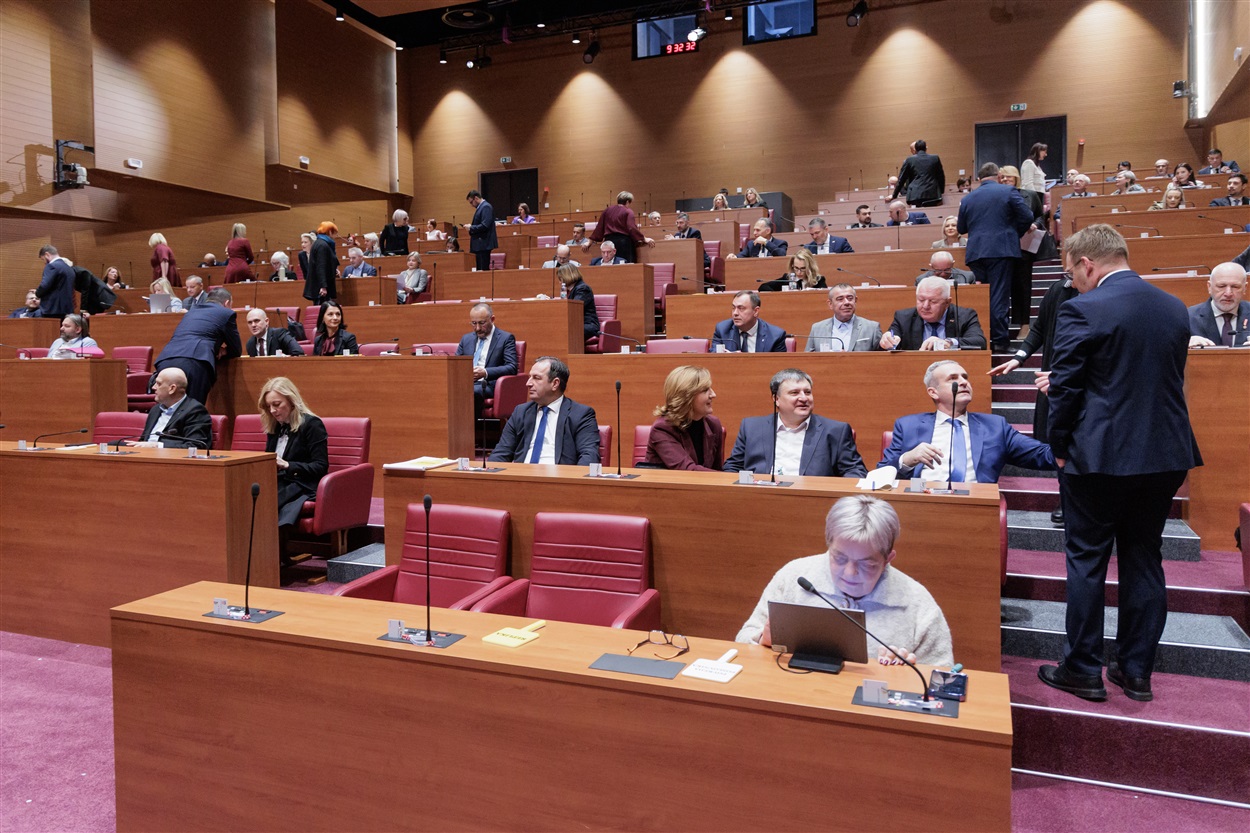
Zagreb - Members of the Croatian Parliament agreed on Thursday that the international order is changing and that Europe and the world are no longer as they were just a few years ago, with territorial ambitions no longer an aberration.
"We are living in a time in which so much happens in just a few months that it feels as though we have lived through an entire decade," Jelena Miloš (We Can!) said during a debate on Prime Minister Andrej Plenković's report on regular European Council meetings held on 23 October and 18 December last year.
She warned that the world today resembles "a major earthquake that simply will not stop", adding that serious crises last year have only deepened.
Mišel Jakšić (SDP) stressed that all of this will bring a great many challenges for Croatia as well, particularly in terms of protecting the interests of citizens, the economy and national interests. He believes the current moment in Europe and the world requires, regardless of political differences, far more communication, dialogue and mutual respect, as well as efforts to find common positions to protect and defend Croatia's interests.
He said communication is needed between Prime Minister Andrej Plenković and President Zoran Milanović, as well as a different kind of communication within Parliament. "If we stand together, we will best protect the interests of the Republic of Croatia," he said.
Jakšić also warned that insufficient use has been made of European funds to change Croatia's economic model, noting that the country is not self-sufficient in agriculture, energy, industry and similar sectors.
Anka Mrak Taritaš (GLAS) said the reports show how much the EU has failed to create a common migration policy, as migrants continue to be treated primarily as a security issue.
She believes it is populists who are building a negative and inflammatory narrative on migration, which she sees as one of the greatest long-term dangers for each EU member state individually and for the EU as a whole. "All this makes the EU weak, divided and unprepared for the challenges ahead," she warned.
Mrak Taritaš also pointed to a stalled transition towards a climate-neutral economy.
Dalija Orešković (DOSIP) warned that the HDZ-led parliamentary majority, as well as the entire right-wing opposition, "is veering away from constitutionalism and from the politics and rhetoric of (the first president) Franjo Tuđman and moving onto the track of fascism."
"Croatia is a state that does not respect its own Constitution, a state of undermined institutions, a state with a very low level of education and civic awareness among its population. If that were not the case, the chant 'For the homeland ready' would not have set the country alight again in 2025," she said.
HDZ MP Andro Krstulović Opara accused the left of lecturing on the period from 1941 to 1945 on the Day of Croatia's international recognition and the Day of the Peaceful Reintegration of the Croatian Danube region. "Stop inventing Ustashas and Partisans. They are invented by those who parasitise on antifascism, who live off antifascism because they have self-promoted themselves as such," he said.
Independent MP Nino Raspudić said that the era of a "climate religion" within the EU is coming to an end in order to strengthen economic competitiveness, while Zvonimir Troskot (Bridge) said the green transition is "the greatest fraud of humanity", arguing that geopolitical realignments are taking place around oil fields and gas deposits in the Arctic.
Marijana Puljak (Centre) said that Europe and Croatia, in an increasingly unstable world, need to take a clear value-based and political stance, adding that messages from US President Donald Trump are calling into question existing security and trade relations.