
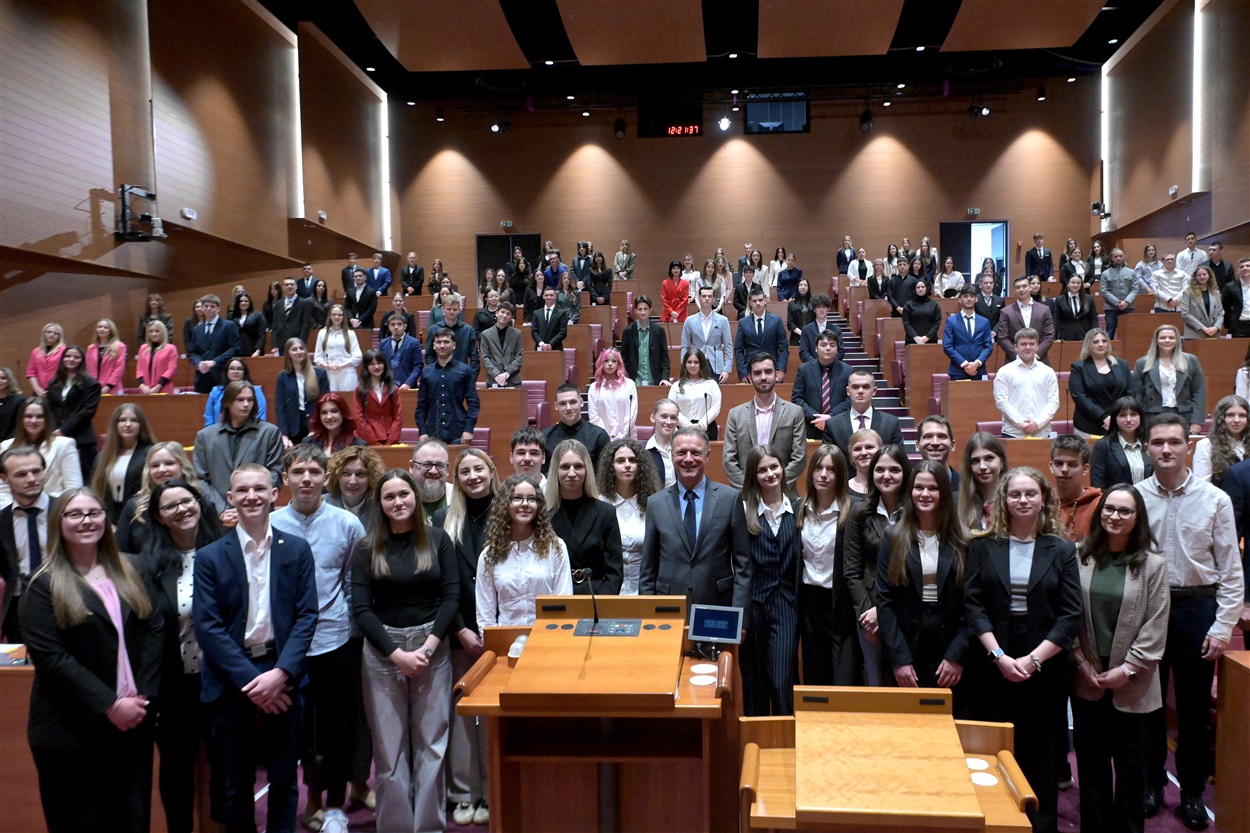
Zagreb - Parliament Speaker Gordan Jandroković told high school students on Monday that the fight for Croatia’s freedom today means ensuring that those from extreme, radical positions who seek to undermine democracy do not become the majority in society.
Jandroković opened the 13th simulated parliamentary session for high school students, which focused on a strategy for Croatia’s demographic revitalisation through 2033.
“Politics is, on the one hand, work for the public good, which is the foundation of any sound, high-quality and honest policy, that all those involved in political life take into account the interests of our state, our citizens and our people, and let that guide their actions. Politics also has party competition, which often pushes into the background what is fundamental, work for the public good, and that political struggle often overshadows the positive measures implemented by the government and the parliamentary majority, as well as the opposition in its own way,” he said.
This happens, he added, because the focus shifts to struggles for power, finances, influence, worldview and identity, and the true purpose of politics is sometimes forgotten. He said this was understandable in a democracy, where differing views on the country’s development are normal, but stressed it was important that conflict remains within acceptable bounds, respecting rights, laws and the constitution.
He said Croatians did not live in freedom and democracy throughout most of the 20th century, until the last decade, noting the absence of media freedom under two totalitarian regimes, something, he added, that may be difficult for students born into democracy to fully grasp.
“Your parents and grandparents did not have that privilege. They lived in times when people could suffer for holding different political views or rejecting the existing system. Many ended up on Goli Otok island, a symbol of repression in communist Yugoslavia, while others lost their jobs and the ability to participate in public life,” he said.
He said that in the 1990s countries in Central and Eastern Europe transitioned from totalitarian systems to democracies, including Croatia. “Unfortunately, we went through the Homeland War and Greater Serbian aggression, but we prevailed and peacefully reintegrated the Danube region. Since then, Croatia has seen unhindered development, achieved internal stability, established democracy and the rule of law, and joined numerous international alliances,” he said.
Croatia still faces many challenges, including healthcare and social protection, energy security and living standards, but compared with many countries worldwide, it enjoys peace, freedom and democracy, he added.
Jandroković also pointed to major shifts on the global political stage, saying that since World War II, with exceptions such as the Croatian 1990s war, the world had operated under a rules-based order that ensured stability and peace, but that order has eroded in recent years, from the COVID-19 pandemic to the war in Ukraine and the Middle East.
He added that climate change and the rapid development of artificial intelligence are transforming everyday life. Addressing the students, he said they face a new set of challenges compared with previous generations, though it is difficult to say whether these will be more demanding, and expressed hope that major wars would not recur and that they would continue to live in freedom and democracy.
A total of 162 students from 57 secondary schools across Croatia took part in this year’s simulated session, organised by parliament’s public outreach service.