
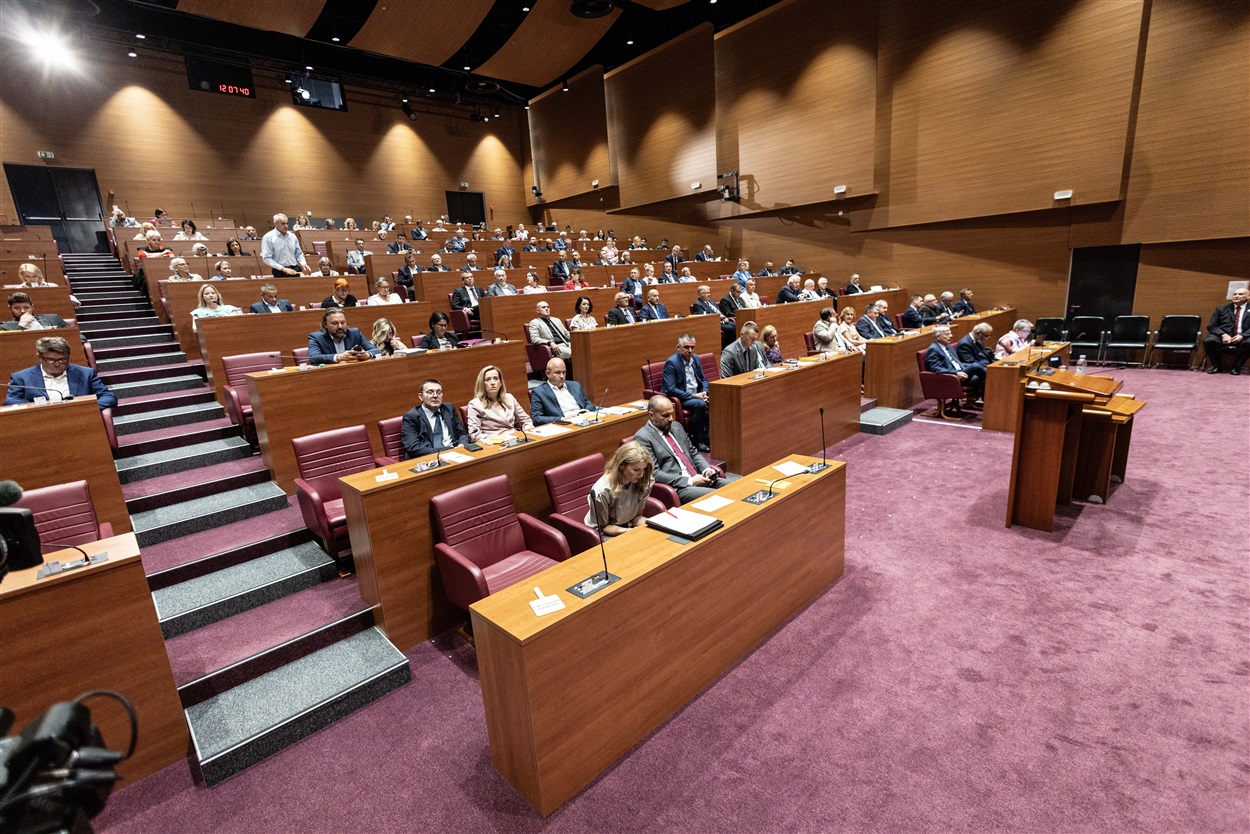
Zagreb - All MPs supported the goal of a resolution proposed by the Homeland Movement (DP) on Tuesday to strengthen the political equality of Croats in Bosnia and Herzegovina, but most questioned whether it could achieve that aim or was mainly intended to boost the sponsors' standing in domestic politics.
The opposition Bridge party and independent lawmaker Nino Raspudić said they would support the resolution despite what they described as the ruling HDZ party's efforts to soften it. Bridge leader Nikola Grmoja said the document had lost DP's key demands and "offers nothing that does not already exist".
Bridge submitted eight amendments seeking to broaden the resolution's objectives to include an explicit call for comprehensive constitutional and political reform in BiH. The amendments also call on the Croatian government to use all political and diplomatic tools, including veto rights in international institutions when the interests of Croats in BiH are threatened.
They also propose declaring as persona non grata political officials who encourage electoral engineering and deny the rights of Croats as a sovereign and constituent people in BiH, as well as banning entry into Croatia for people who deny or insult Croatian identity.
Bridge's amendments further seek protection for Croats throughout BiH, including in the Serb-dominated Republika Srpska entity, a review of allegedly unlawfully acquired Croatian citizenships, an obligation for the Croatian government to report to parliament on implementation of the resolution, and the launch of international consultations on a permanent solution for the position of Croats in BiH if no progress is made.
Bridge also proposed removing the Mostar Agreement, arguing that it did not deserve to be part of an official Croatian document.
Bridge, as well as the opposition SDP and We Can!, called for Croatia's cooperation to include all relevant Croatian political and social actors in BiH, rather than only one party or political organisation.
Raspudić said HDZ had continued a policy of concessions regarding the position of Croats in BiH.
"It is time for Croatia... to clearly condemn the decisions that have led to the unequal position of Croats in BiH. Plenković's HDZ is not pursuing Croatian policy towards BiH, but French and Brussels policy, and that policy has proven to be anti-Croatian. This is already a treasonous policy... and it is good that Croats in BiH can see what kind of support they have from this government," he said.
Left-wing opposition says BiH Croats resolution lacks consensus
Left-wing opposition parties and representatives of national minorities said the resolution would not solve their problems and had been drafted without broader political consensus.
SDP lawmaker Arsen Bauk said the issue of Croats in BiH must remain above day-to-day politics and that the resolution largely repeated Croatia's existing positions.
"The preamble lacks a clear condemnation of all actions and policies that have had or still have the aim of dismantling BiH, dividing it, threatening its territorial integrity and undermining the equality of its constituent peoples and all its citizens," Bauk said.
He added that such wording would show that parliament was not taking sides but standing by principles, that "we oppose any attempt to marginalise Croats, but also any attempt to dismantle BiH."
Jelena Miloš of the We Can! party said the document brought nothing new and that the issue could only be resolved through an agreement among political representatives in BiH, with support from Croatia and the European Union.
"Croatia should give priority to supporting BiH's path towards the EU. It is unclear what the resolution was intended to achieve, since even the sponsor acknowledged that it does not introduce concrete measures," she said.
GLAS lawmaker Anka Mrak Taritaš said she viewed the document primarily as DP "flexing muscles" against HDZ and an attempt to improve its image rather than a genuine effort to resolve the issue.
She said too little attention was being paid to the demographic survival of Croats in BiH, noting that their constitutional status and equality could only be preserved if they continued to actually live there.
Igor Peternel of the DOMiNO party said he feared the "true purpose" of the declaration was aimed at domestic audiences rather than BiH. "Unfortunately, the Croatian national cause in BiH has become a performance of occasional, ceremonial and folkloric patriotism," he said.
SDSS and Bosniak minority MP against resolution
Milorad Pupovac of the Independent Democratic Serbian Party (SDSS) and Bosniak minority lawmaker Armin Hodžić opposed the resolution.
Pupovac said DP lacked the political credibility to address the issue and that its approach was deepening rather than resolving divisions in BiH.
"At elections in Croatia, DP does to Serbs what it would not want done to Croats in BiH. It remains silent on the underrepresentation of a large number of Croatian citizens when it comes to their voting rights, and it is pursuing this initiative to stop the collapse of its own ratings," Pupovac said.
"You have played your Vukovar cards, holding that city hostage to your politics; you have played your anti-Serb cards, holding Croatia hostage to such politics, and now you have taken up the Croatia-Bosnia and Herzegovina cards. Stop doing this," he added.
Hodžić also questioned whether the resolution would genuinely help Croats in BiH. He said he supported full political equality for Croats and electoral reform, but argued that this could only be achieved through political agreement within BiH.
"My vote is a vote for a BiH in which the Croatian people will be fully equal, but where that will be achieved through political agreement, not through further mutual distancing," Hodžić said.
Ruling bloc backs resolution
Tomislav Josić of DP said the resolution set "the direction of Croatian state policy toward BiH for the years ahead", stressing that it was a parliamentary act that, for the first time, clearly, argumentatively and historically assessed the role of the Croatian Community of Herzeg-Bosnia and the Croatian Defence Council.
He also said the resolution came at an important moment as elections in BiH approached and Croats continued to face uncertainty over whether they would again be exposed to "electoral engineering".
Zdravka Bušić of HDZ said protecting Croats in BiH represented a vital interest of Croatia and was not merely a phrase.
"The resolution is based on the principle of legitimate political representation of the Croatian constituent people and does not prescribe constitutional solutions for BiH. Final solutions must result from an agreement among legitimate political representatives in BiH," she said.
HSLS also backed the resolution. Its leader Dario Hrebak said the political equality of Croats was not only a Croatian issue but also a matter of the stability and survival of BiH as a state.
He also proposed considering a model of long-term institutional development for BiH based on European NUTS 2 principles.