
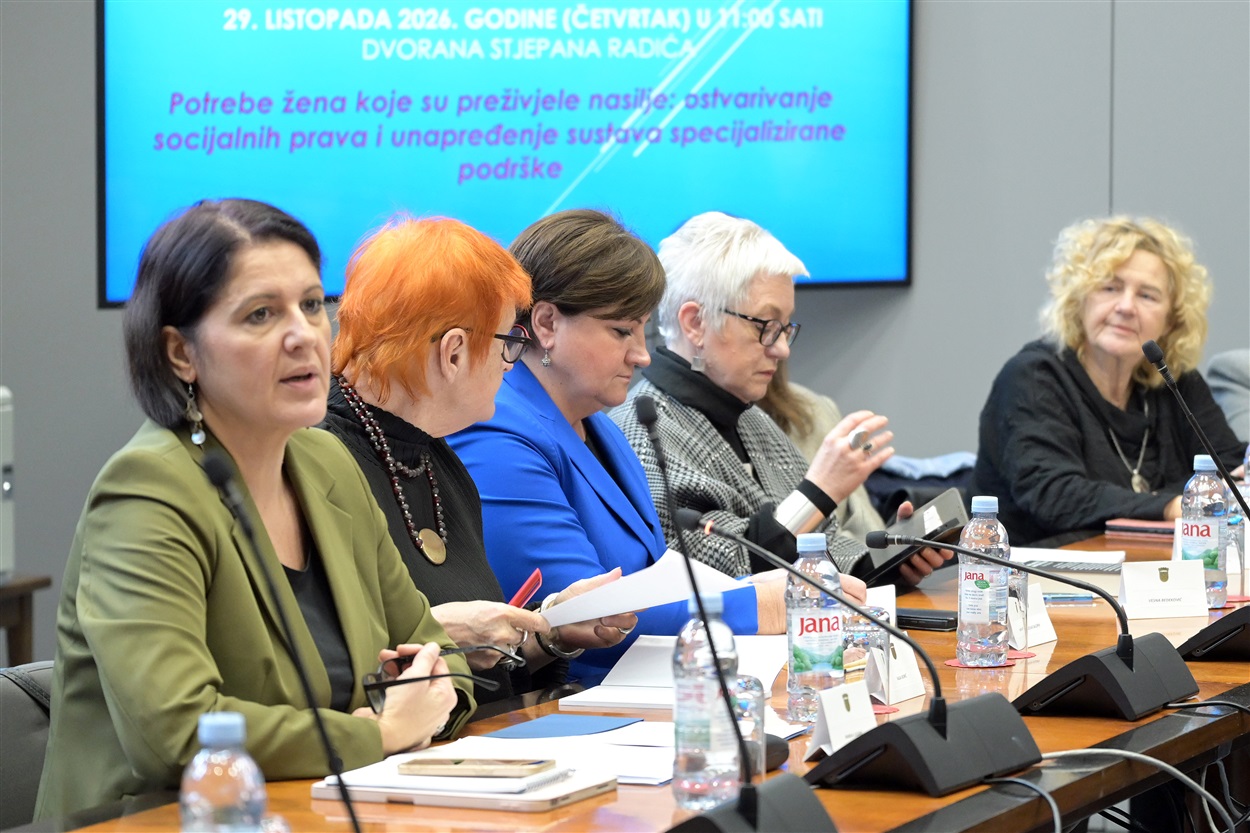
Zagreb - The Sabor's Gender Equality Committee held a thematic session on Thursday, at the initiative of the Croatian Women's Network, focusing on the needs of women who have survived violence. Participants highlighted barriers to accessing rights and called for continuous, accessible support.
Speakers stressed that women leaving abusive relationships must have access to safe housing, employment, continuous healthcare and timely childcare. They also pointed to the gap between rights guaranteed by law and their availability in everyday life.
Committee chair Marija Lugarić said leaving an abusive relationship often marks the beginning of a difficult period in which women must simultaneously secure housing, income and childcare while rebuilding control over their lives. Protection, she said, must not depend on where a woman lives, her financial resources or her ability to navigate administrative procedures.
Juras: Analysis reveals barriers to accessing rights and services
Sanja Juras of the Croatian Women's Network presented an analysis based on questionnaires completed by local and regional authorities and organisations providing specialised support. Although the findings are not statistically representative of the whole country, they point to areas requiring targeted action.
According to the analysis, 26 local government units have no special procedure for quickly registering the residence of women who have left abusive homes, despite the fact that registered addresses can affect access to benefits, childcare and other services.
Half of the 62 local government units responding to a question on economic empowerment reported having no such measures, while 43 of 63 reported no available housing support measures.
Juras stressed that employment cannot be addressed separately from childcare, safe housing and professional assistance. The Network is calling for continuity of rights after relocation, protection of women's and children's location data, long-term housing solutions and stable multi-year funding for shelters and counselling centres.
Women's organisations call for earlier intervention and better institutional support
Dorotea Šušak of the Centre for Women's Studies said support must be available as soon as women consider reporting violence. She highlighted the need for timely risk assessments, child protection and measures to prevent secondary victimisation by institutions.
Sanja Batinjan of the HERA association in Križevci called for comprehensive safety assessments when deciding on children's contact with perpetrators. She also pointed to unclear responsibilities regarding residence registration, health insurance and kindergarten enrolment, saying administrative obstacles take time away from trauma recovery.
Lorena Zec of SOS Rijeka highlighted high rents, housing discrimination and lengthy procedures as barriers to finding safe accommodation. She also warned that women often have to cover relocation costs themselves and disclose sensitive personal information to prospective landlords.
Snježana Vasiljević, a professor at the Zagreb Faculty of Law, said state responsibility extends beyond criminal prosecution and protective measures to ensuring that women can safely support themselves and their children.
She identified fragmented legislation, complex procedures, regional inequalities and additional barriers facing women with disabilities, Roma women and older women.
The sustainability of specialised support services was another key issue. Maja Mamula of the Women's Room warned that insufficient funding threatens the survival of centres for victims of sexual violence and the continuity of professional assistance. We Can! MP Rada Borić also criticised reliance on annual funding calls and local authorities' goodwill, saying organisations providing direct support need stable financing.
HZZO: Changing family doctors could be made easier through regulations
Martina Furlan of the Croatian Health Insurance Fund (HZZO) said women who relocate because of violence can already change their chosen doctor before the usual one-year period expires. She suggested that a specific provision for such cases could be introduced through a regulation, without amending the law, making it easier for women and children to continue treatment after moving to safety.
Danica Kramarić of the Health Ministry outlined efforts to increase the number of child and adolescent psychiatrists and expand psychological counselling services at health centres, available without a referral.
Gender Equality Ombudswoman Vesna Ljubičić stressed the importance of women's economic independence and warned against institutional practices that disregard violence or treat both parents as equally responsible.
State Secretary at the Ministry of Justice, Public Administration and Digital Transformation Ivan Crnčec discussed individual victim and risk assessments and the alignment of legislation with the European legal framework, noting that criminal justice measures alone are insufficient.
Organisations call for practical protection and long-term support
Valentina Andrašek of the Autonomous Women's House Zagreb said procedures must provide effective protection and institutions need a better understanding of trauma and the fear associated with reporting violence.
Desa Kolesarić of SOS Virovitica warned that the lack of housing, employment and support for children can contribute to women returning to perpetrators. Assistance, she said, should not be delayed until court proceedings are completed.
Dubravka Šimonović of the Paritet sada (Parity Now) association and Irena Sarta of the government's Office for Gender Equality highlighted Croatia's international obligations and the need for comprehensive, accessible services that enable women to rebuild their lives with dignity.
Concluding the session, Lugarić called for continued cooperation between public institutions and civil society organisations to remove barriers and improve support for women who have survived violence.