
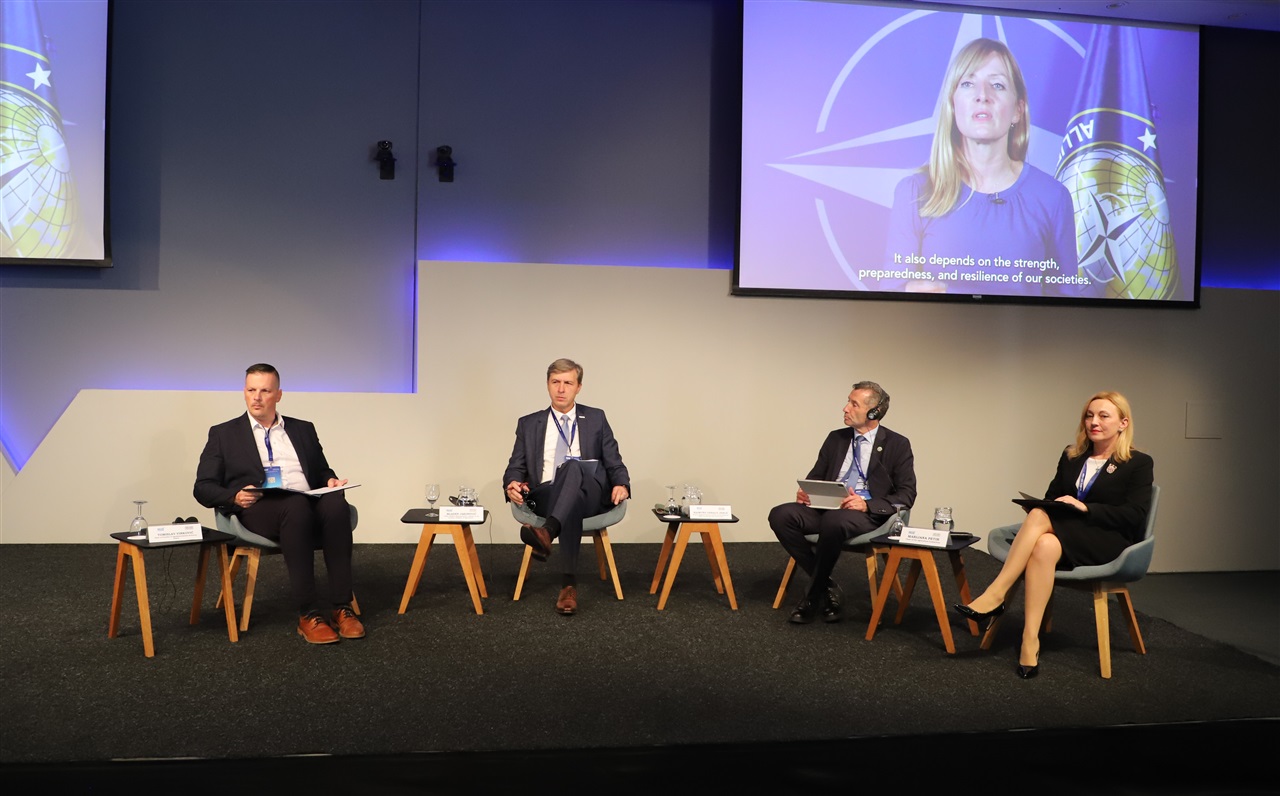
Dubrovnik - The third and final panel of the Interparliamentary Conference “From Field to Sea – A Common Vision for EU Food Security and Strategic Autonomy”, held in Dubrovnik and organised by the Agriculture Committee of the Croatian Parliament as part of the parliamentary dimension of the Republic of Croatia’s presidency of the EU MED 9 group, focused on food security as a pillar of national security and resilience.
Marijana Petir, Chair of the Agriculture Committee of the Croatian Parliament and moderator of the panel, stressed that a country cannot be secure and resilient in the long term if, in times of crisis, it is unable to ensure sufficient food for its citizens. Domestic production is the first pillar of resilience, but security of supply depends on the functioning of the entire chain – from production and processing to storage, logistics and distribution.
Petir presented the Agriculture Committee’s proposal that strategic agri-food and fisheries infrastructure be recognised as critical infrastructure essential to national security and resilience, and that part of the funding available under NATO’s new commitment for member states to invest in defence and security be made available for its financing. The Allies have committed to spending 5% of GDP on defence and security requirements by 2035, with up to 1.5% of GDP that can be allocated to the protection of critical infrastructure, civil preparedness and resilience, innovation and the defence industrial base.
“If food is a vital need of citizens, ensuring a reliable food supply must be a vital responsibility of the state”, Petir said, stressing that infrastructure serving food production, processing and supply in peacetime becomes a cornerstone of national resilience in times of crisis.
Vlasta Zekulić of NATO’s Allied Command Transformation addressed participants via video link, noting that the modern concept of security has expanded significantly beyond the traditional defence domain. Resilient food and water supply systems are part of national resilience requirements, including the ability to maintain production, storage, processing, transport and distribution in the face of major disruptions.
Stressing the importance of linking food security with civil preparedness, critical infrastructure protection and defence planning, she highlighted the key role of national parliaments: ensuring through legislation, budgets and oversight that the necessary capacities are built and protected before a crisis occurs.
Raimund Jehle, a representative of the FAO Regional Office for Europe and Central Asia, stressed that recent crises have underscored the importance of food security as a key dimensions of national resilience. It depends not only on the amount of food produced or stored, but on the resilience of the entire agri-food system.
He drew particular attention to the links between climate extremes, water scarcity, wars and geopolitical disruptions, as well as rising energy, input and food prices. The Mediterranean is particularly exposed due to increasing pressure on water and other natural resources.
Resilience, he said, is built through investment in water and soil management, production diversification, local processing and storage capacities, cold chains, logistics, energy, biosecurity and early warning systems, with regional cooperation being one of the important prerequisites for national resilience.
COPA-COGECA representative Mladen Jakopović pointed to the continued decline in the number of farmers and the concentration of production on larger farms across Europe, stressing the need for stronger support for small and medium-sized farms, which play an important role in diversifying production and strengthening the resilience of the food system.
He identified investment in processing, product quality and short supply chains, as well as generational renewal, as key priorities. Future funding for the Common Agricultural Policy, he said, will be crucial to preserving a diverse and competitive European agricultural sector and encouraging young people to remain in farming.
Tomislav Vinković, Dean of the Faculty of Agrobiotechnical Sciences in Osijek, highlighted the importance of science and education in strengthening food security. He identified research, digital technologies, early warning systems and the education of professionals capable of linking food production with crisis management as key areas.
“If food security is understood as an integral part of national security, then we must build the resilience of Croatian agriculture before a crisis occurs – through production, infrastructure, knowledge and people,” Vinković said.
During the discussion, food security was highlighted as one of the foundations of national and European strategic autonomy. Participants stressed the need to reduce strategic dependencies on third countries, strengthen domestic production and processing, and increase the resilience of agriculture to climate change and increasingly frequent extreme weather events.
Particular emphasis was placed on water resource management and irrigation, food safety, animal disease control and strong veterinary systems, as well as investment in agricultural and rural infrastructure, science, digitalisation and domestic production capacities. Participants also emphasised the importance of creating a more level playing field for European producers vis-à-vis imports from third countries, while ensuring stable and predictable support for farmers.
At the close of the conference, Marijana Petir announced that the conclusions would be shared with the European Commission and Parliament, national parliaments and conference participants, providing input for the shaping of European policies and the next programming period.
She stressed that political decisions must be based on the realities on the ground and that direct contact between parliamentarians and farmers and fishers is essential to understanding their needs.
Preserving rural, island and coastal areas, she noted, also means preserving national security, culture, tradition and identity.
Petir highlighted three key messages from the conference:
1. Farmers need a stable and predictable Common Agricultural Policy, adequate funding and rules that take the specific characteristics of the Mediterranean into account.
2. Sustainability in fisheries must go beyond restrictions and also take into account economic and social sustainability, as well as the vitality of island and coastal communities.
3. Food security is a matter of national security and resilience, with domestic production, strategic and operational reserves, and infrastructure ensuring continuity of supply in times of crisis forming its foundations.
She concluded that agriculture and fisheries are increasingly exposed to market, climate and geopolitical disruptions over which producers often have little or no control. They therefore need legal and financial certainty, as well as a clear, understandable and workable regulatory framework.
“If we want a secure food supply, we must ensure security and stability for those who produce our food,” Petir said in her closing remarks.